Cuba
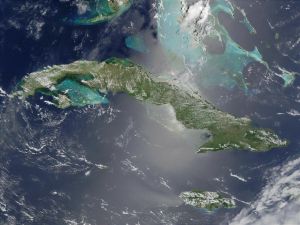
The Republic of Cuba (Spanish: República de Cuba, IPA: ) consists of the island of Cuba (the largest of the Greater Antilles), the Isle of Youth and very numerous adjacent small islands. more...
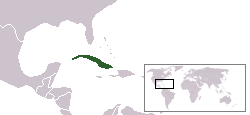
The name Cuba is said to be derived from the Taíno word cubanacán, meaning "a central place." At least as early as colonial times Cuba was the name given to areas near Santiago de Cuba. It is located in the northern Caribbean at the confluence of the Caribbean Sea, the Gulf of Mexico and the Atlantic Ocean. Cuba is south of the eastern United States, and the Bahamas, west of the Turks and Caicos Islands and Haiti, and east of Mexico. The Cayman Islands and Jamaica are south of eastern Cuba.
History
Cuba was first visited by Europeans when explorer Christopher Columbus made landfall there for the first time on October 28, 1492, at the eastern tip, in the Cazigazgo of Baracoa. In 1511 Diego Velázquez de Cuéllar led the Spanish invasion, subdued the indigenous population, to become governor of Cuba for Spain and built a villa in Baracoa, which became the first capital of the island and also in 1518 was technically the seat of the (Diocese) of the first bishops of Cuba. At that time Cuba was populated by at least two distinct indigenous peoples: Taíno and Ciboney (or Siboney). Both groups were prehistoric neolithic, perhaps copper age, cultures. Some scholars consider it important to distinguish the Taíno from the neo-Taíno nations of Cuba, the Lucaya of the Bahamas, Jamaica, and to a lesser extent from Haiti and Quisqueya (approximately the Dominican Republic), since the neo-Taíno had far more diverse cultural input and a greater societal and ethnic heterogeneity than the true high Taíno of Boriquen (Puerto Rico). Most of pre-Colombian inhabitants of Cuba, including the Siboney, can in first approximation be classified under the general group of neo-Taíno. The Taíno were skilled farmers and the Ciboney were a hunter-gatherer society with supplemental farming. Taínos and Ciboney took part in similar customs and beliefs, one being the sacred ritual practiced using tobacco called cohoba, known in English as smoking.
Read more at Wikipedia.org